
The Hidden Cost of Misalignment
Let’s suppose you’re building an even smarter fishtank. You’re adding temperature and salinity sensors, logging timestamped readings to flash. The struct is your binary record format – every field at a fixed byte offset, so you can read it back on any system that knows the layout.
You use fixed-width types from stdint.h and #pragma pack(1) to strip out
compiler-inserted padding. This is the advice I had always received and given,
and it’s correct – as far as it goes.
But pack(1) costs more than you think. It destroys the compiler’s ability to
generate efficient code for every field access, including fields that are
perfectly aligned.
On RISC-V, a single 32-bit store to an aligned field in a pack(1) struct
compiles to 7 instructions instead of 1!
In this post, we show how to fix using the packed and aligned attributes,
and how to avoid byte-decomposition even as the struct grows in the future.
Table of Contents
A Sensor Record
Here’s a struct you might find in any embedded codebase – a timestamped sensor reading destined for flash storage or transmission over the wire:
#pragma pack(push, 1)
typedef struct {
    int64_t  timestamp;       // offset 0,  8 bytes
    int32_t  temperature_mc;  // offset 8,  4 bytes (millidegrees C)
    int32_t  salinity_ppt;    // offset 12, 4 bytes (parts per thousand)
    uint8_t  status_flags;    // offset 16, 1 byte
    uint16_t battery_mv;      // offset 17, 2 bytes
} sensor_reading_t;           // 19 bytes, no padding
#pragma pack(pop)
The structure is packed to preserve offsets between platforms (so the same C code can read it out on a PC, for example), and secondarily to eliminate padding bytes that would waste space. This is reasonable and very common in embedded code.
Why pack structs at all? Without packing, the compiler inserts padding bytes between fields to satisfy alignment requirements. Historically, the size and placement of that padding differed quite a bit across architectures1 – modern compilers are somewhat more consistent, but the padding bytes still waste space and can surprise you when designing a wire or storage format. Packing removes this instability: you get a fixed, deterministic byte layout regardless of where the code is compiled.
Here’s what that looks like. The unpacked version of this struct is 24 bytes – 5 bytes of hidden padding:
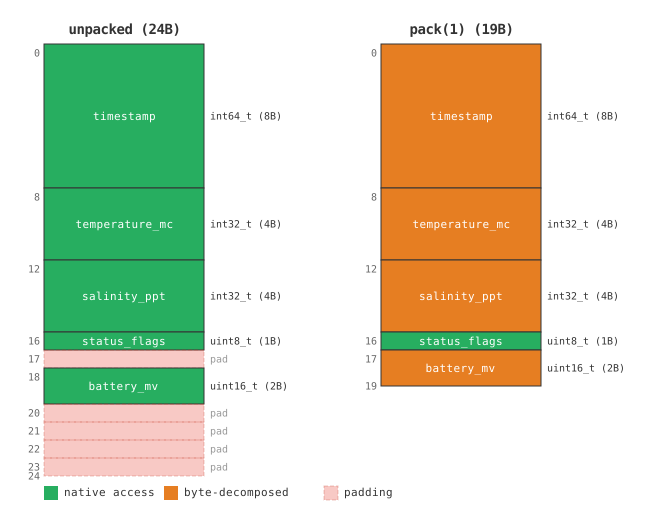
But you will see that we labeled most of the entries in the packed structure as “byte-decomposed”, even for fields that are aligned relative to the start of the struct! This is a hidden performance bomb.
What the Compiler Actually Emits
Look at temperature_mc at offset 8. It’s a 4-byte integer sitting at a
4-byte-aligned offset. One would think the compiler would emit a single store
instruction for this, but take a look at what actually happens.
Here’s the RISC-V disassembly (compiled with riscv64-elf-gcc at -O2):
;; entry->temperature_mc = value;
;; value in a1, entry pointer in a0

srli    a3, a1, 0x8       ; extract byte 1
srli    a4, a1, 0x10      ; extract byte 2
srli    a5, a1, 0x18      ; extract byte 3
sb      a1, 8(a0)         ; store byte 0
sb      a3, 9(a0)         ; store byte 1
sb      a4, 10(a0)        ; store byte 2
sb      a5, 11(a0)        ; store byte 3
Seven ops! Three shifts and 4 byte-stores – to write a single int32_t to a
perfectly aligned offset. Without pack(1):
sw a1, 8(a0) ; one op
Every field in the struct gets this treatment. Writing the 64-bit timestamp at
offset 0 is even worse – 14 ops instead of 2. Not just the misaligned fields.
All of them.
Why this happens.
#pragma pack(1)sets the type’s maximum alignment to 1. That means a pointer to this struct could legally point to any byte address. The compiler can’t look at your code and determine that in practice, these structs always live inmalloc‘d memory (aligned), on the stack (aligned), or in larger aligned structures. The type system says alignment is 1, so every access gets byte-decomposed. This isn’t a bug. You told the compiler “trust nothing about this struct’s alignment.” The compiler took you at your word.
The Fix: packed + aligned
GCC and Clang support combining __attribute__((packed)) with
__attribute__((aligned(N))). The packed attribute controls internal layout
(no padding between fields), while aligned sets the struct’s own alignment
requirement:
typedef struct __attribute__((packed, aligned(4))) {
    int64_t  timestamp;       // offset 0  -- native access
    int32_t  temperature_mc;  // offset 8  -- native access
    int32_t  salinity_ppt;    // offset 12 -- native access
    uint8_t  status_flags;    // offset 16 -- byte access either way
    uint16_t battery_mv;      // offset 17 -- still byte-decomposed
} sensor_reading_t;           // 20 bytes (19 content + 1 byte tail padding)
The field offsets are identical. The struct gains 1 byte of tail padding (so its size is a multiple of 4), but the binary layout of the fields themselves doesn’t change. What changes is what the compiler knows: the base pointer is always 4-byte aligned.
That lets the compiler do the math:
-
timestampat offset 0: 4-aligned base + 0 = aligned. Native store (2 ops).2 -
temperature_mcat offset 8: 4-aligned + 8 = aligned. Native store (1 op). -
salinity_pptat offset 12: 4-aligned + 12 = aligned. Native store. -
status_flagsat offset 16: byte access regardless. No change. -
battery_mvat offset 17: 4-aligned + 17 is odd. Still byte-decomposed – correctly.
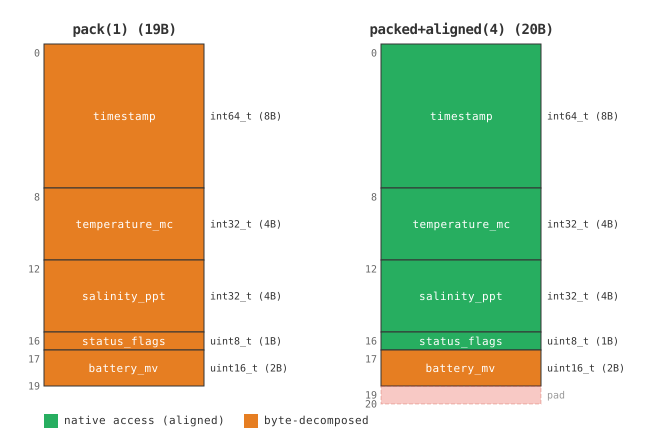
The genuinely misaligned field (battery_mv at offset 17) is still handled
safely.3 But the aligned fields – which are the majority of this struct
– go from 7 ops to 1.
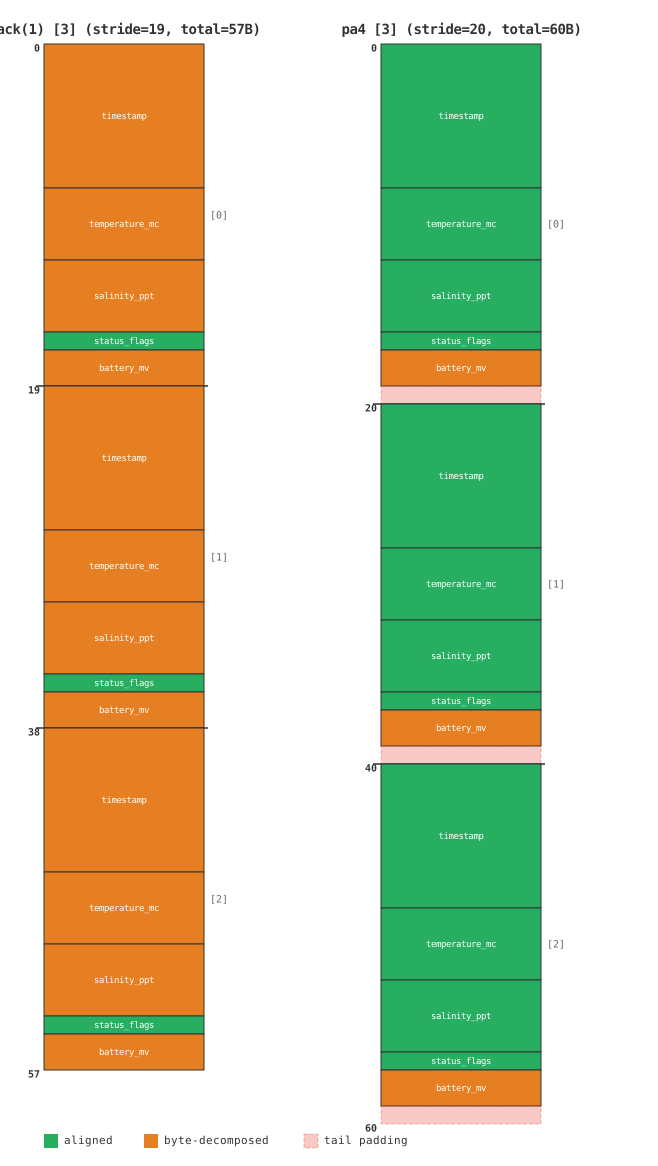
When you can’t switch: arrays of packed structs. If your packed struct is already used in a contiguous array – in flash, in a file format, over the wire – switching to
packed, aligned(4)changes the array stride. Elements that were at offsets 0, 19, 38, 57… would now be spaced 20 bytes apart. This breaks binary compatibility with existing data.For existing formats with arrays of packed structs, you’re stuck with
pack(1)unless you can migrate the data. For new formats, usepacked, aligned(4)from the start.
Here’s what that looks like in practice. With pack(1), elements pack tightly
at 19-byte intervals. With packed, aligned(4), each element is padded to 20
bytes4 so the next element starts at a 4-byte-aligned offset:
Struct Evolution
Your struct is well-designed. The aligned fields get native access, the misaligned ones are handled correctly. You ship it.
Six months later, someone extends the struct in a pull request. They append a
uint32_t error_code:
typedef struct __attribute__((packed, aligned(4))) {
    int64_t  timestamp;
    int32_t  temperature_mc;
    int32_t  salinity_ppt;
    uint8_t  status_flags;
    uint16_t battery_mv;
    uint32_t error_code;      // NEW -- offset 19
} sensor_reading_t;
The struct was 19 bytes of content before, so error_code lands at offset 19 –
not 4-aligned. No compiler warning. No test failure. The code works fine. But
that field gets the full byte-decomposition treatment:
;; entry->error_code = code;
srli    a3, a1, 0x8
srli    a4, a1, 0x10
srli    a5, a1, 0x18
sb      a1, 19(a0)
sb      a3, 20(a0)
sb      a4, 21(a0)
sb      a5, 22(a0)
Seven ops for what should be one.
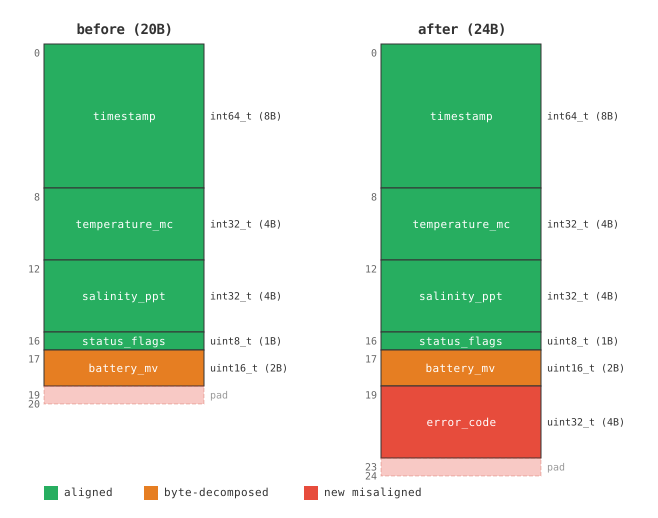
The bigger risk. Inserting fields into a packed struct breaks binary compatibility with anything already using the old layout – devices in the field, stored records, protocol peers. Appending fields is safe (old readers simply ignore the extra bytes), but insertion shifts every subsequent offset. I recommend using defense in depth where CI rejects field insertion (by comparing struct layouts against a baseline) and integration tests decode packets or records from old firmware versions. That’s a topic for a future post.
The fix for this particular struct would be to insert explicit padding before
error_code so it lands at offset 20:
    uint16_t battery_mv;
    uint8_t  _reserved;       // explicit padding to maintain alignment
    uint32_t error_code;      // now at offset 20 -- native access
This is easy to miss in code review, whether human or automated. This is why you lint.
Catching misalignment with struct-lint. struct-lint reads DWARF debug info from ELF binaries and reports fields that aren’t naturally aligned within packed structs:
$ struct-lint firmware.elf

sensor_reading_evolved_t.battery_mv (uint16_t, 2 bytes) at offset 17 not naturally aligned (needs 2)
sensor_reading_evolved_t.error_code (uint32_t, 4 bytes) at offset 19 not naturally aligned (needs 4)

2 issues in 1 structs across 1 file (2 alignment, 0 missing pack)
It catches exactly the kind of silent misalignment that happens when structs evolve over time. Run it against your build artifacts and you’ll know which fields are paying the byte-decomposition penalty.
There is also a tool called pahole which can inspect structs based on the DWARF info. Pahole has been around for almost 20 years and is even integrated into the Linux kernel build system. Output from
paholefor the same examplesensor_reading_evolved_tstruct is:type`def struct { int64_t timestamp; /* 0 8 */ int32_t temperature_mc; /* 8 4 */ int32_t salinity_ppt; /* 12 4 */ uint8_t status_flags; /* 16 1 */ uint16_t battery_mv; /* 17 2 */ uint32_t error_code; /* 19 4 */ /* size: 24, cachelines: 1, members: 6 */ /* padding: 1 */ /* last cacheline: 24 bytes */ } sensor_reading_evolved_t __attribute__((__aligned__(4)));>where you can see the offsets and sizes of each member of the structure. This output may be helpful for debugging and manual inspection of structures.
paholealso offers flags where it can recommend restructuring for performance.struct-linton the other hand is intended as a linter for your CI pipeline, and to provide feedback on stdout that looks like compiler errors so that it’s maximally actionable for devs and coding agents.
Not Just RISC-V
The examples above are RISC-V, but this affects all embedded architectures.
Here’s the same 32-bit write (temperature_mc at offset 8) across seven
targets:
| Architecture | pack(1) |
packed, aligned(4) |
Ratio |
|---|---|---|---|
| RISC-V 32 (rv32imac) | 7 ops (3 srli + 4 sb) |
1 op (sw) |
7x |
| Xtensa (ESP32) | 7 ops (3 extui + 4 s8i) |
1 op (s32i.n) |
7x |
| ARM Cortex-M0 | 7 ops (2 lsrs + lsls + 4 strb) |
1 op (str) |
7x |
| MIPS32 | 2 ops (swl + swr) |
1 op (sw) |
2x |
| macOS arm64 | 1 op (str) |
1 op (str) |
1x |
| i686 | 1 op (movl) |
1 op (movl) |
1x |
| x86_64 | 1 op (movl) |
1 op (movl) |
1x |
Most embedded targets we tested show the same 7× byte-decomposition overhead –
different ISAs, different compilers, same pattern. The exception is MIPS32,
which has dedicated unaligned store instructions (swl / swr) that reduce the
overhead to 2×.
Desktop architectures (arm64, x86) produce identical code regardless of packing. They handle unaligned access in hardware and may pay a microarchitectural penalty (cache line split, extra cycles) – but thankfully on embedded targets we can just inspect the disassembly to know exactly what we’re paying.
Conclusion
#pragma pack(1) is a blunt instrument. It tells the compiler “nothing about
this struct’s alignment can be trusted.” In most embedded codebases, that’s far
more pessimistic than reality – you packed the struct to get a stable binary
layout for serialization, not because you actually access it through misaligned
pointers.
Use __attribute__((packed, aligned(4))) to say what you actually mean: no
padding between fields, but the struct itself lives at an aligned address. Your
code gets smaller and faster, and the compiler still correctly byte-decomposes
the fields that genuinely need it.
As your structs evolve, alignment can silently degrade. A new field appended at the wrong offset, and you’re back to 7x the ops with no warning from the compiler. Lint it like you lint everything else.
Individually, these are small wins – single-digit percent improvements in code size and throughput. But embedded mastery is the accumulation of these details. Getting the small things right so the compiler can do its job is how you build systems that are fast, small, and correct.
See anything you'd like to change? Submit a pull request or open an issue on our GitHub
References
- struct-lint: DWARF-based struct alignment linter
- GCC Type Attributes: packed, aligned
- ARM Cortex-M0 Technical Reference Manual: Unaligned Access
-
Endianness is another portability concern when designing binary formats – see the portability aside in the embedded database post. Here we’ll focus on what
pack(1)does to your generated code. ↩ -
On a 32-bit ISA there is no single 64-bit store instruction, so two 32-bit stores is already optimal and
aligned(4)is sufficient. If you target a 64-bit core (e.g. RV64, AArch64) and want a singlesdorstr, usealigned(8). ↩ -
There’s a bonus for misaligned reads, too. With
pack(1), readingbattery_mvrequires two byte-loads and a reassembly (4 ops). Withpacked, aligned(4), the compiler knows offset 16 is 4-aligned, so it does a single word-load from there and shifts out the uint16_t (3 ops). Knowing where aligned boundaries are lets the compiler use wider loads even for misaligned fields. ↩ -
A small bonus: array indexing is faster with a 20-byte stride than a 19-byte stride. Multiplying by 20 decomposes into simple shifts and adds, while multiplying by 19 requires an extra subtraction. The difference is minor but it’s free. ↩
 Chris Merck is Co-Founder and CTO at Bond.